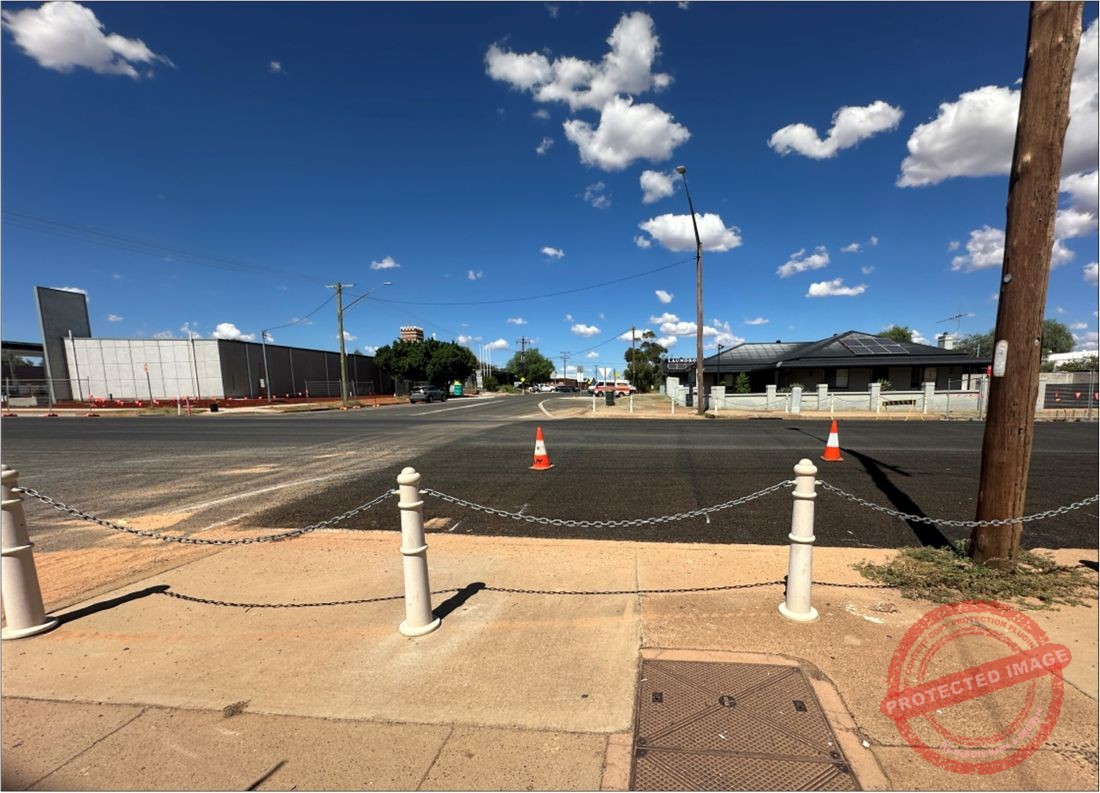
bollards have now been installed at the Marshall Street and Bourke Street intersection to deter pedestrians from crossing the highway at that point.
Work to remove the pedestrian crossing at the intersection of Marshall and Bourke streets (on the Barrier Highway) was carried out last week and is part of a broader safety upgrade led by Transport for NSW.
According to project documents, the crossing was earmarked for removal as part of works to transform the town centre into a 40 km/hr High Pedestrian Activity Area (HPAA), which aims to improve overall safety and traffic flow.
The crossing, which was popular with school children, was no longer considered safe with poor visibility for motorists and pedestrians cited as reasons for its removal.
An alternate pedestrian crossing about 50 metres east of the Marshall and Bourke streets intersection was deemed a preferred safer option for school children and seniors.
Rather than eliminating pedestrian access, the redesign shifts priority across the entire street.
In low-speed zones like Cobar’s CBD, drivers are expected to give way to pedestrians at all points, reducing reliance on a single marked crossing.
Planning documents developed in collaboration with Cobar Shire Council indicate the intersection was simplified to minimise conflict between vehicles and pedestrians, particularly with turning traffic.
The intersection has become much busier over the past few months during the construction of a new service station on the highway opposite the Shell Cobar Auto Port.
There is expected to be more turning traffic coming and leaving at that intersection when the service station opens for trade.
Existing crossing infrastructure was repurposed into traffic-calming features, including gateway treatments designed to slow vehicles and increase driver awareness.
While the changes are intended to improve safety outcomes, some residents have noted the absence of a clearly marked crossing point can make navigating the intersection feel less certain.
Transport for NSW advises the upgrade forms part of a wider strategy to create safer, more pedestrian-friendly town centres by lowering speeds and redesigning streetscapes.