Dear Editor,
I am writing regarding the recent article from the Nature Conservation Council of NSW (NCC). [The Cobar Weekly, edition May 6, 2026] .
While some valid points were raised, I have serious concerns about the long-term management of the Western Division.
As a landholder, business owner and father in this region, I believe producers must be given the autonomy to undertake management strategies that create both environmentally and financially sustainable outcomes.
My concerns centre on the treatment of Invasive Native Scrub (INS) and broader landscape management.
I strongly agree that mature, hollow-bearing trees should be protected for the critical habitat they provide.
The NCC is also correct that this area was historically grassy woodland, not forest.
However, they fail to acknowledge how dramatically soil condition has declined under dense stands of INS.
In this semi-arid, brittle environment, dense scrub suppresses perennial grasses, increases bare ground, erosion and water runoff, and restricts the ground cover needed for a stable landscape.
The INS issue has been documented since the early 1900s.
Historical accounts describe this region as abundant in grasses, edible shrubs and absorbent soils. C.E.W Bean’s book, ‘On the Wool Track’ documents this extensively.
Today, that description feels like science fiction.
Are landholders expected to stand by and watch continued deterioration under a suffocating blanket of INS, while also carrying the financial burden?
We are often told to leave country alone, yet land subject to long-term rest (more than 50 years) is often no better than surrounding areas. In these environments, total rest is not restoring thriving ecosystems.
I regularly drive through properties that are part of the National Park areas.
I do not see an environment that is thriving with life or perennial grass cover.
I see a stark and barren landscape, devoid of life.
I see an overwhelm of bare ground and eroded gullies that splinter the earth.
The few remaining open areas are in the early to advanced stages of the INS invasion.
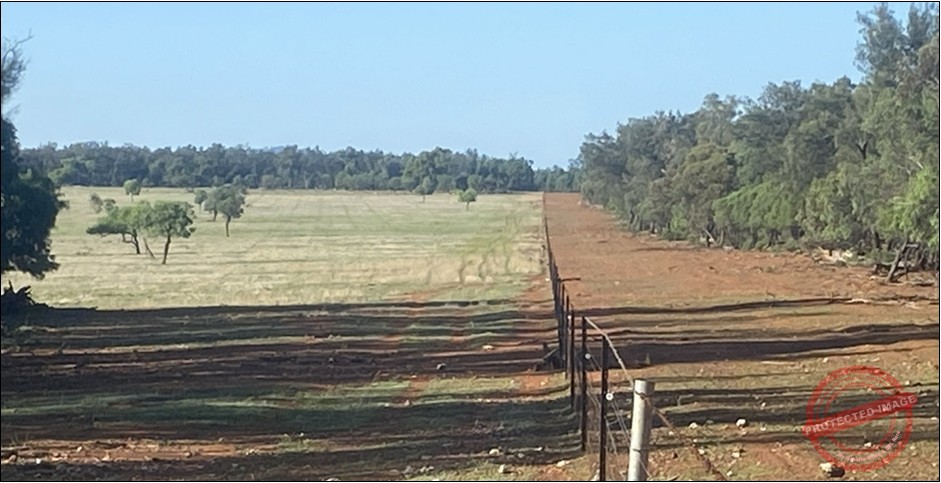
The photo below was taken along a fenceline on our property in March 2026.
On the right-hand side, is a paddock that has been fenced to keep out feral goats and unwanted grazing pressure.
There has not been any domestic stock grazing this area in the last two years.
It is mainly covered in dense INS – White Cypress pine of similar age that germinated in the 1930’s or 40’s, with some remnant areas of Belah.
On the left-hand side is an area that has been treated and managed to restore the mosaic grassy woodland.
It has excellent groundcover with predominantly native perennials that
It has the old hollow bearing trees as well as clumps and belts of mixed timber species.
We have developed a property plan in conjunction with the Western Local Land Services to identify which areas to treat and how to treat them.
We, along with many other landholders, are working to restore the balance and repair our native perennial woodlands.
The NCC is trying to protect a highly altered and, in some cases, a highly degraded landscape.
We should be doing more than just locking up this country.
We need to use all the tools at our disposal to restore the balance in this landscape.
This includes cool season burning, mechanical treatment, resting areas periodically and using managed grazing.
Regional communities are sick of bearing the load of poor legislation developed in Sydney and Canberra that is not delivering results for the local community or the environment.
The majority of the landholders are doing the right thing.
We have a framework that is working.
We understand the ecosystem we manage.
We just need to be given the autonomy and support to make decisions that do deliver meaningful impacts for the landscape, our businesses, communities and families.
Andrew Mosely
Landholder