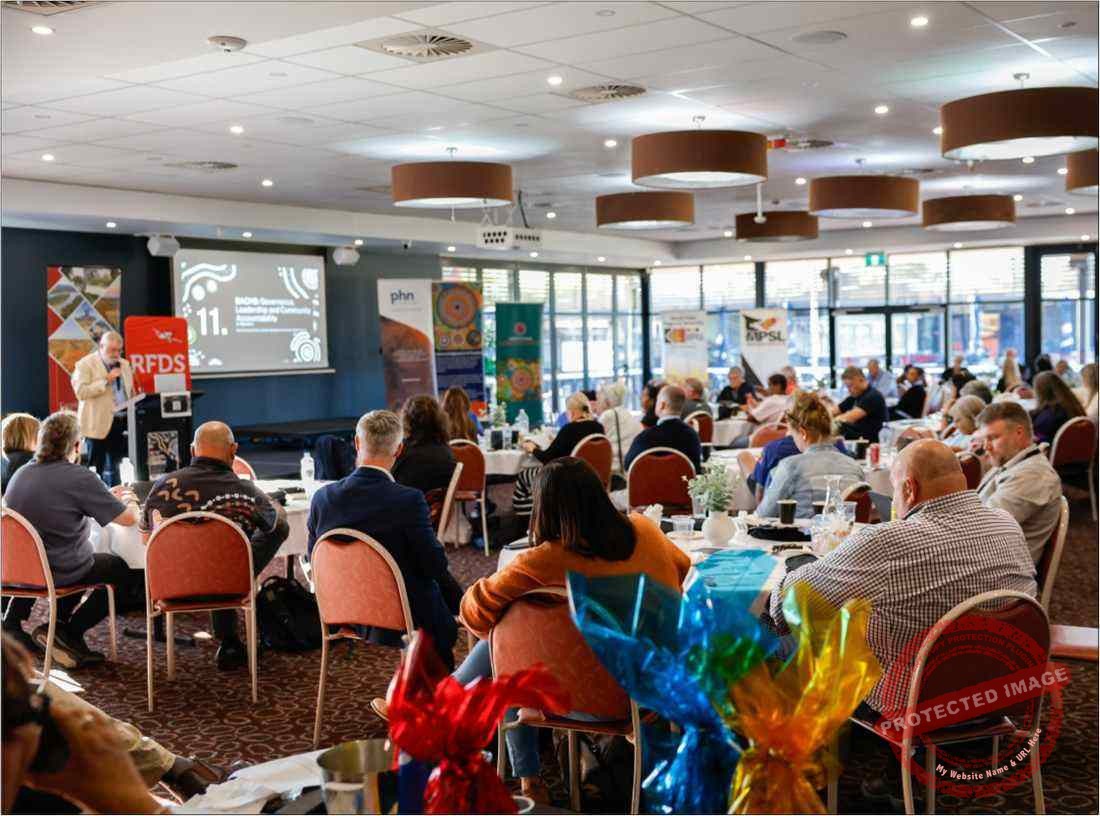
Cobar became the centre of an important regional conversation about Aboriginal health this week, with Aboriginal community leaders, Aboriginal Community Controlled Health Services, major health providers and NSW Government representatives gathering in town.
The 2026 Murdi Paaki Aboriginal Health Leadership Symposium, hosted by the Murdi Paaki Regional Assembly (MPRA) on Monday and Tuesday, brought representatives from across the Murdi Paaki Region and NSW together under the theme Building Stronger Relationships for Improved Health Outcomes in the Murdi Paaki Region.
The two-day event provided an opportunity for community leaders, the community-controlled health sector, health organisations and government to share information, hear directly from those working with communities and consider how they can work differently together to improve Aboriginal health outcomes.
The Symposium opened on Monday with a Welcome to Country and official opening, followed by an address from MPRA Chairperson Grace Gordon, who reflected on the Murdi Paaki story and more than three decades of Aboriginal leadership in the region.
A key message was that while governments, policies, programs and funding arrangements may change, communities remain.
The Murdi Paaki model has been built from the grassroots up, with Community Working Parties providing a local structure for Aboriginal people to identify their own priorities and bring those priorities together through the Regional Assembly.
Ms Gordon said that history provided an important foundation for the health discussions, with communities holding significant knowledge about the issues affecting them and needing a meaningful role in determining the responses.
Participants heard from health professionals, Aboriginal Community Controlled Health Services, the Western NSW Primary Health Network, the Royal Flying Doctor Service and NSW Government representatives, including NSW Treasury.
The discussions highlighted the challenges facing Aboriginal people across the region, while also recognising the leadership, expertise and capability that already exists within communities and Aboriginal Community Controlled Health Services.
Participants also heard that improving Aboriginal health outcomes cannot be achieved by one organisation, service or government agency working alone.
Health and wellbeing are connected to mental health and social and emotional wellbeing, culturally safe care, workforce, transport, housing and environmental health, families, culture and community infrastructure.
Addressing these issues requires organisations to work across traditional boundaries and around priorities identified by local communities.
For MPRA, an important part of the Symposium was bringing representatives from the community, Aboriginal Community Controlled Health sector, regional health organisations and government together in Cobar to listen to one another and develop a better understanding of the regional picture.
“Our communities have been identifying their priorities and advocating for better outcomes for many years,” Ms Gordon said.
“What has been encouraging is seeing people make the commitment to come to Cobar, listen to what our communities and services are telling us and have an open conversation about what needs to change.
“We all share the objective of improving Aboriginal health outcomes. “The important part now is working out how we turn that shared commitment into action.”
The second day of the Symposium built on Monday’s discussions, with a focus on Local Decision Making in the Murdi Paaki Region and lessons from MPRA’s work in housing and environmental health.
The housing experience provided a practical example of what can be achieved when community priorities are connected with evidence, shared decision-making, investment and the capacity to implement.
The Symposium then focused on the commitments and next steps needed to continue the work beyond the two-day event.
Ms Gordon said the success of the Symposium would ultimately be measured by what happens after the conversations in Cobar.
“We are not going to solve every issue in two days, but we can develop a better shared understanding of the challenges, strengthen the relationships between the people who need to work together and be clearer about what needs to happen next,” she said.
“Our communities will continue to be here regardless of changes in government policy or programs.
“What matters is whether we can build ways of working together that are strong enough to turn community priorities into action.”