The petition to save Cobar’s historic Town Hall building has now garnered over 800 signatures from some very passionate residents, however there was only a handful in attendance at the Mayor’s Town Hall Working Group meeting on Monday night.
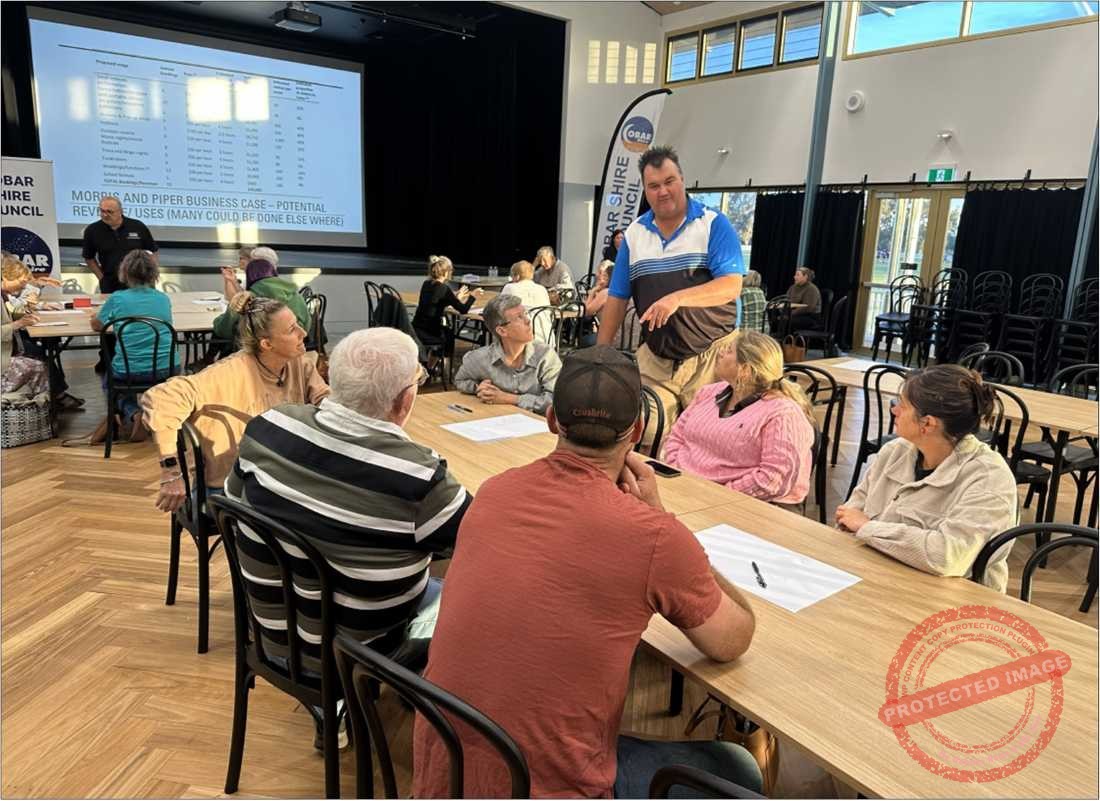
A dozen members of the community, along with five Councillors and seven Council staff, attended the first of Mayor Jarrod Marsden’s proposed three meetings to discuss the future of the Town Hall.
The series of meetings aim to determine a viable future use for the hall.
Cr Marsden explained the first session was to give residents an overview of Council’s situation and some background information as to why the Councillors had decided to demolish the building.
He said the building itself has significant safety, compliance, and access issues, with the upper floor currently closed.
Consultants were engaged in late 2023 to provide Council with a Town Hall redevelopment business case and their findings were released in March 2024.
The business case offered Council three options: 1. Do nothing, 2. Full demolition/or partial demolition and 3. Refurbishment into a multi-use open community space.
Option 3, which aimed at preserving heritage elements while improving usability at an estimated at cost of $3 million, was initially preferred by Councillors before they recently revisited the topic and voted to look at demolishing the building.
Cr Marsden said the deciding factor in discussions about the Town Hall should not be money.
He said however any construction costs to restore the building would need to come from grant funding and would not be borne by ratepayers.
Cr Marsden explained that while some external grant funding exists, most is highly restricted, including a recent $3 million Federal Government grant Council received to deliver the design and planning works for the CBD.
He stressed that this funding was to be used for design work only and cannot be used for construction works.
“The final design decisions for the CBD/Grand Precinct are required by March 2026,” he said.
“So that’s why we have a March deadline,” Cr Marsden said.
He said that if money is to be invested, the hall would need to be used regularly, not just a few times a year, and ideally supported by a long-term tenant or management committee.
During Monday night’s meeting, community members highlighted the hall’s heritage value, its role in the local tourism heritage walk, and its potential to host small exhibitions, arts use, and flexible community activities.
Others questioned its architectural significance and economic viability, emphasising that alternative venues already exist within town.
Participants were invited to put forward their practical future uses for the hall which included an art gallery/display space, small spaces for businesses to rent, a meeting room, accommodation for large groups of visitors, band practice and concerts, flexible wall spaces/dividers, markets, formal balls, a pop-up restaurant/bar, a community Co-Op, a micro museum, space for pop-up retail and a convention space.
Cr Marsden said Council will take all the ideas gathered from Monday night’s meeting and collate them to present to the next meeting early in the new year.
“From there we’ll refine them and get that list down to the top three or top five to present to the March Council Meeting,” he said.