Fuel prices—everybody is talking about them, social media is making jokes about the high prices but everyone is worrying about how high they will go.
The surge in prices and fuel shortages across Australia, particularly in rural areas, comes in response to global oil disruptions as a result of the US war against Iran.
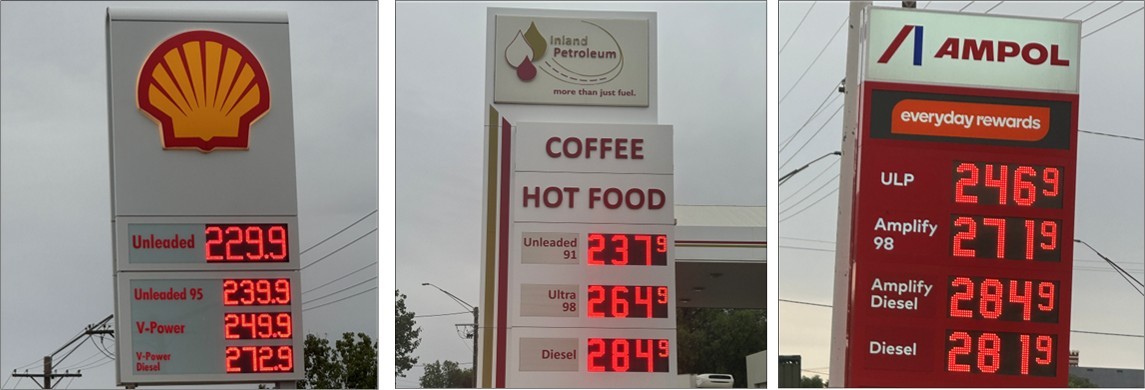
As of yesterday morning, unleaded prices in Cobar were 229.9 cents per litre at Cobar Shell Auto Port, 237.9 at Inland Petroleum and 246.9 at Ampol, while diesel was selling for 272.9 at Shell, 281.9 at Ampol and 284.9 at Inland.
Cobar’s fuel prices are comparable with Dubbo fuel stations with unleaded ranging from 227.5 cents per litre to 236.9 and diesel was selling from 269.5 to 284.9 cents per litre yesterday.
They are also not much dearer than Sydney’s fuel prices.
According to the NRMA’s Weekly Fuel Report, the average price for regular unleaded fuel in Sydney is 229.6 cents per litre (as of Monday afternoon).
The NRMA reports average regular unleaded prices have risen 12.4 cents per litre this past week.
The average diesel price in Sydney is 271.1 cents per litre, which has risen 49.6 cents this past week.
According to the report, regional prices last week for unleaded rose 29.6 cents per litre on average while diesel prices rose 51.2 cents per litre.
Robert Kirby, owner of the Cobar Shell Auto Port and Coonamble Roadhouse service stations, gave The Cobar Weekly an insight into how his fuel prices are set.
“We are contracted to get all our fuel from Viva Energy, which is the Shell license holder in Australia,” Mr Kirby said.
He said Viva Energy charges a terminal gate price, which changes daily (except for Sunday and Monday) and their prices are published.
“That price is set according to a formula, approved by the ACCC.
“It’s based on Singapore refined product and they add an agreed shipping cost, a standard shipping cost to Australia.”
He said a margin is added to that (which is once again agreed by the ACCC) and that becomes the approved ACCC wholesale price.
“We then have to, negotiate our own cartage. Our fuel comes from Shell’s, Rosehill Terminal,” Mr Kirby said.
“We pay a hired carrier to bring the fuel up.
Mr Kirby said they negotiate a cartage price to bring the fuel to Cobar and Coonamble.
“They’re currently, as of last week, putting a surcharge on for fuel, which is very understandable,” he said.
Mr Kirby works off spreadsheets to work out when they get their fuel, the date it was invoiced, and how much they paid for it.
“We are pricing according to the date that the fuel was purchased because we buy it in Sydney when it was loaded.”
Mr Kirby said he takes into consideration a number of factors before he then adds his profit margin.
“We look at a number of things. One would be, what we think is fair, and two, it’s what the opposition is doing. And in trying to evaluate those, we come up with a price.
“At the moment, our margins are probably a little bit less than what they normally are.
“Because we wanted to do the right thing by the local people, and not get any reputation for gouging.
“I’m trying to come out with our reputation intact or even enhanced,” Mr Kirby said.
With fuel prices currently jumping between eight and 15 cents a day, he said it would however be hard for anyone to believe that he’s trying to look after locals.
“There’s a lot of people trying really hard, but if you look at the prices and you look at service stations running out, it’s not evident of all the effort being put in, but there is an enormous amount of effort being put in by people all over the place,” he said.
Mr Kirby said there’s a number of factors that have led to fuel shortages in rural areas and include long wait times for carriers to fill up (which impedes on their driver log hours and delays delivery) and many independent bulk fuel suppliers have to a degree been cut off .
He said that was evident in Coonamble, which is a predominantly wheat growing area with farmers buying their bulk supplies from independents.
Mr Kirby said in addition to the rush on fuel from average motorists panic buying in the first week and a half (which varied from town to town), people in Coonamble were trying to fill up everything they could.
“In the first day or so, we went through an enormous amount of fuel until we had to put a limit on what people could get, because we can’t supply bulk fuel.
“We just don’t have the facilities to do that.
“But I think things are steadied down now.”
Cobar Auto Port has seen some panic buying of diesel fuel and they have had to put a one pod/drum limit on their customers which includes mining and local contractor businesses who use large quantities of fuel for their fleets of vehicles.
Tourists traffic doesn’t have appeared to have slowed down yet, but local staff expect it will eventually, particularly if fuel prices continue to rise.