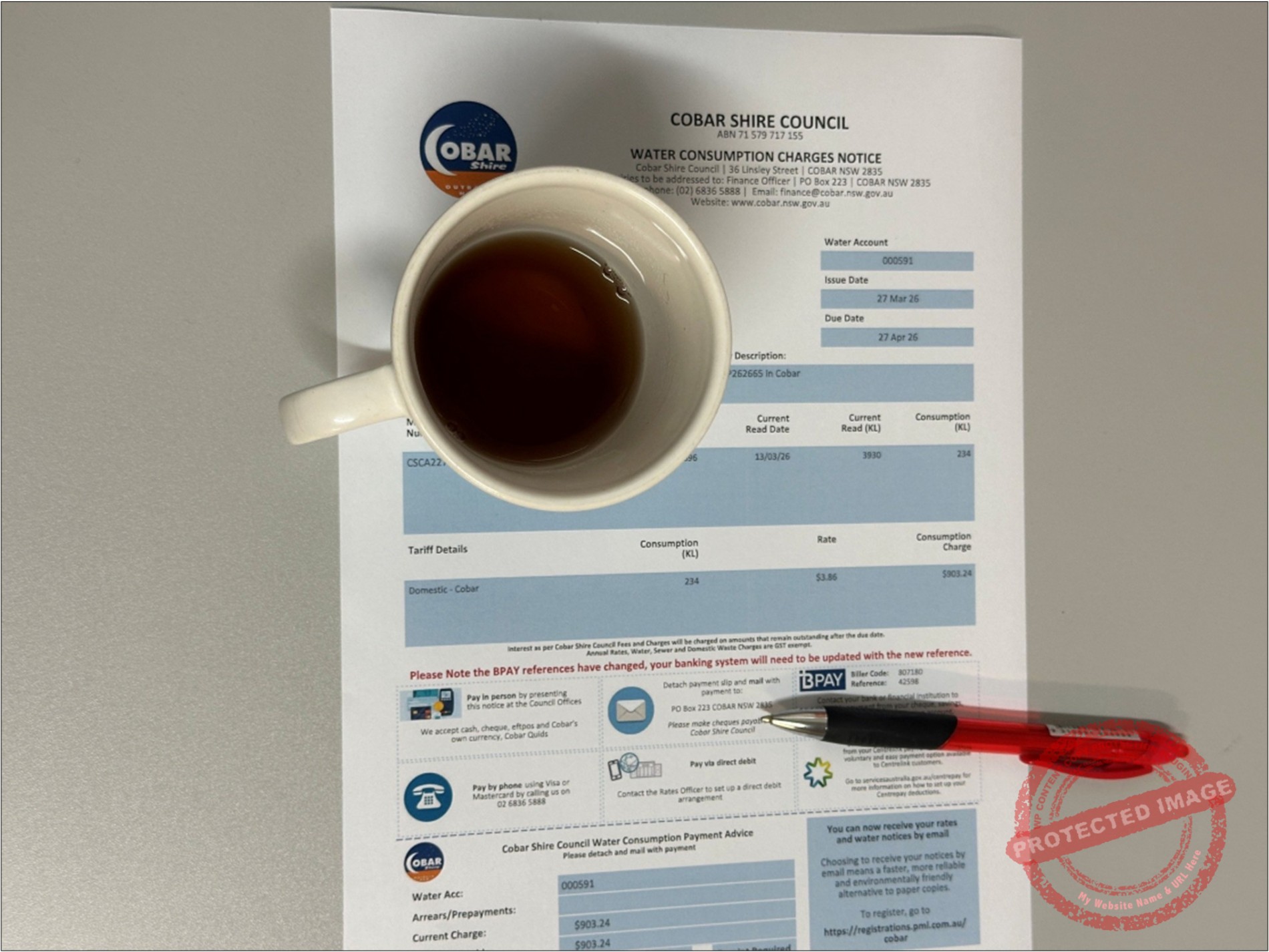
consumption charges as part of its 2026-2027 Fees and Charges schedule.
Domestic water charges in Cobar have nearly doubled since 2014-2015 and, with another price hike coming next month, Cobar residents are being urged to keep a close eye on their water consumption.
Cobar Shire Council general manager Peter Vlatko is concerned that many households may not realise the impact of the increase until their next bill arrives.
At last month’s Ordinary Council Meeting, Council approved its 2026/2027 Fees and Charges which included a 4.4 per cent increase in the water charge to $4.03 per kL up to 550kL and a 4.53 per cent increase to $8.07 per kL for consumption of over 550kL.
Council advises water charges are designed to cover the cost of providing water, using a dual-pricing system.
Ratepayers are billed an access charge (with differing rates for both residential and commercial properties) as well as a usage fee per kL of water used.
Water is billed quarterly with water meters read in September, December, March and June.
Mr Vlatko said while Council regularly receives complaints each quarter from residents about their water bills, there was, however, no feedback or submissions received from concerned residents when the proposed 2026-2027 Fees and Charges were out on public exhibition for a month prior to their approval at the May meeting.
He said many residents may not be aware there has been another price increase.
Mr Vlatko said the price of water was based solely on the cost of supplying it to consumers.
“It is the cost of what it takes us to produce water to your property.”
“That’s all it is. There’s no profit,” he said.
“It’s whatever it costs us and people need to remember that our water comes all the way from Warren.”
He said the cost of delivering water has continued to rise and it costs Council more money to deliver the service.
Mr Vlatko said supplying Cobar’s water involved maintaining a lengthy supply network
“Don’t forget it comes through 70 kilometres of Albert Priest channel which we pay Bogan Shire Council to maintain.
“That’s part of the business, about $280,000 a year.”
On top of that, we also pay for the pumping and the infrastructure of the 130km pipeline to get the water here.
“It’s normally about two million dollars.”
Mr Vlatko said Council’s water account was required to stand on its own financially.
“The water fund is actually a business in the council.
“The Act requires it to be self-funded.
“It can’t be subsidised by the general fund or anything else.”
Mr Vlatko said the State Government did not contribute to Cobar’s potable water supply costs.
“Nothing. Not one cent.”
He also pointed to water losses before the supply reaches Cobar.
“The Cobar Shire Council’s water licence is measured at Warren.
“We lose 50 per cent of it before we get it here.”
He said future costs could continue to rise as ageing infrastructure required renewal.
“If it was to actually have to pay for renewals, then the water wouldn’t be $2 million, it’d probably be $4 million.”
Mr Vlatko acknowledged that water charges had increased significantly over time.
In the 2014-2015 financial year, Council’s water charges were based on a three-tier basis with a charge of $2.10 for usage up to 450kL, $3.10 for 451-550kL and $4.00 for over 550kL.
By 2023-2024, when Council had a two-tier system, fees were imposed at $3.50 for
0-550kL and $7.00 for over 550kL.
Council imposed its biggest increase in the 2024-2025 year of 8.57 per cent on 0-550kL to $3.80 and 7.14 per cent on usage over 550kL to $7.50.
Mr Vlatko said for many years Council was undercharging for water consumption and it needed to be brought back into line.
He said the cost of water was not linked to inflation.
“The cost of water equates to water costs.”
He said the water fund was designed to cover operating expenses and future upgrades.
“The water fund does not make a profit but it is supposed to be sustainable,” he said.
With water charges set to increase next month, Mr Vlatko encourages local residents to reduce unnecessary water use and identify water leaks on their property before they become expensive.
“I think it’s important that people understand that water is not just something that comes out of the air.
“It is actually a product that costs them the money.”
Householders are being encouraged to monitor their water meters regularly.
“Have a look at your meter at night before you go to bed,” Mr Vlatko recommended.
“And when you wake up in the morning, have another look before you turn anything on.
“If it’s moved, understand why it’s moved.”
He said it could have moved because you have a leak.
“Repair any dripping taps and leaking toilets.
“Every drop is dollars.”
He also encouraged residents to recycle water where possible. For example running water off your washing machine on to the lawn.
Mr Vlatko said the aim was not to discourage people from maintaining their homes and gardens but to encourage smarter water use.
“We still need water.
“But it is a product that actually costs a lot of money to deliver it.”
He said residents should think about their water consumption before receiving their quarterly account.
“I want the community to understand that they should have a look at their water, not when they get their bill, but before they get their bill.
“Look at it before it becomes a problem rather than after it’s become a problem.”
Mr Vlatko said residents with concerns about their water bills should contact council staff for assistance.
“I want to encourage people to come and talk to us about their water.
“And more importantly, Council is keen to show people how to save or to maximise it and not to have to pay for water that they don’t need.”